


Episode 14: Markets Work

This episode opens an eight-part series walking through the Awaken Wealth investment philosophy, with Markets work as the first idea. We look at what the stock market is, how prices get set, what a century of returns shows, and what all of it means for your retirement.
In this episode
- What a stock is, what "the market" means, and how a 1906 ox-weighing contest explains the way prices form
- Eugene Fama's Efficient Market Hypothesis (EMH), and why efficient doesn't mean always right
- The ten-dollar Van Gogh: how competition between informed buyers sets fair prices
- Why some investments carry higher expected returns than others
- How's the water? The 1960s database that finally measured what the stock market paid
- Index funds 50 years after "Bogle's Folly," and what happens if everyone indexes
- Three lessons for your retirement
Research and data
- Eugene Fama, "Efficient Capital Markets: A Review of Theory and Empirical Work," Journal of Finance (1970)
- The 2013 Nobel Prize in Economic Sciences: Eugene Fama, Lars Peter Hansen and Robert Shiller
- Francis Galton, "Vox Populi," Nature (1907)
- Sanford Grossman and Joseph Stiglitz, "On the Impossibility of Informationally Efficient Markets," American Economic Review (1980)
- Eugene Fama and Kenneth French, "The Cross-Section of Expected Stock Returns," Journal of Finance (1992)
- Eugene Fama and Kenneth French, "A Five-Factor Asset Pricing Model," Journal of Financial Economics (2015)
- Center for Research in Security Prices (CRSP)
- MSCI All Country World Index (ACWI): country weights
- Investment Company Institute, Active and Index Investing, August 2026
- Axios, "The first stock index fund turns 50" (August 31, 2026)
- Morningstar, Mind the Gap 2026
- Fulkerson, Jordan, Riley and Yan, "Bad Timing Does Not Cost Investors 15% of Their Funds' Returns," Financial Analysts Journal (2026)
- Brad Steiman, "Relying on Market Prices" (2018)
Book and film
- David Booth, Stay Calm: Learn to Embrace Uncertainty in Investing and Life (2026) | Buy on Amazon
- Tune Out the Noise, a documentary by Errol Morris
Related listening
- Retire Ready Podcast, Episode 13: Talking Your Money with Carl Richards
- Carl Richards, Behavior Gap
- Rational Reminder, Episode 381: Investing 101
- Rational Reminder, Episode 183: Market Efficiency Myths and Misconceptions
Coming up next
Episode 15: Don't Play the Loser's Game. We open up the SPIVA Canada Scorecard (S&P Indices Versus Active), which tracks how often active fund managers beat their benchmarks.
Resources
Key Takeaways
- Trust prices more than predictions.
- Control the things you can actually control.
- Have a plan before markets become scary.
Transcript
Welcome to the Retire Ready Podcast, the podcast that helps Canadians prepare for all that retirement brings. I am your host, Scott Sather, founder, president, and financial planner at Awaken Wealth Management, and portfolio manager with Awaken Investments of Aligned Capital Partners in Regina, Saskatchewan.
Thanks for joining me today
So in the last several episodes, we've covered a lot of mechanics of retirement savings in Canada, the RRSP, the TFSA, the RRIF, and locked-in accounts like the LIRA.
Today, I want to zoom out from all of that. This is the first of an eight-part series walking through the investment philosophy we use at Awaken Wealth. One idea per episode, and we're starting with the one that sits underneath all the others: markets work. So what do I mean by that? Financial markets are incredibly competitive mechanisms for taking all of the information, opinions, expectations, and uncertainty that exist out there and turning them into prices.
[00:01:00] That doesn't mean markets always go up, that prices are always exactly right, or that investing is risk-free. And once you understand that, I think it changes the way you invest. Because instead of continually asking, "What is the market going to do next?" You start asking a better question, "How do I build a plan that lets the market work for me?" And that's where we're headed today. We'll start with what we actually mean by the market, then look at how prices get set, what a century of market history shows, what happens if everyone buys index funds, and what all of that means for your retirement.
So let's start at the beginning. Because we use the phrase the market all the time without stopping to say what it is. When you buy a stock, you're buying a small piece of ownership in a business. What that piece is worth today depends on what the business is expected to earn in the future and how much uncertainty comes with it.
The market is shorthand for all the buying and selling of those pieces that happen every business day. Pension funds, banks, hedge funds, and individual investors are all trading with one another, [00:02:00] and every trade needs a buyer and a seller who agree on a price. If they don't agree on that price, the transaction doesn't happen
Each of those trades adds a little information to the price. Put millions of them together on a daily basis, and the price becomes the crowd's best combined estimate of what a business is worth. There's an old story that shows how that happens. In 1906, at a livestock fair in Plymouth, England, about eight hundred people entered a contest to guess the weight of an ox. The scientist, Francis Galton, collected the tickets afterward, and when he lined up all the guesses, the middle one was twelve hundred and seven pounds. The ox weighed one thousand one hundred and ninety-eight. No one in that crowd knew the answer, but together, they missed by less than one percent. A stock market runs the same contest every day with a lot more money at stake and a lot more expertise in the crowd. When a newscaster says the market was up today, they're usually quoting an index. An index is a list of companies that [00:03:00] stands in for a whole market, like the S&P/TSX Composite here in Canada or the S&P five hundred in the US or the Dow Jones is a common one as well. Most indexes are weighted by size, so a company worth twice as much counts twice as much. An index fund simply buys everything on that list in the same proportion. Rather than trying to pick winners, you own the market at the price the crowd has already set. John Bogle launched the first index fund for everyday investors around fifty years ago this past August. Critics called it Bogle's Folly, and we'll come back to how that turned out a little later.
The businesses you own through the market employ people, build products, develop technology, solve problems, and hopefully earn profits. Capital markets allow businesses to raise money to do those things, and they allow investors like you and me to participate in their growth. Over long periods of time, that system has created tremendous wealth. But here's an important distinction: markets creating wealth doesn't mean [00:04:00] markets move smoothly. Prices are constantly adjusting because expectations are constantly changing. A company reports better earnings than expected, and the price reacts.
Interest rates change, and the market reacts.
A new competitor shows up, and the market reacts.
A recession becomes more or less likely, and again, the market reacts.
And importantly, markets aren't waiting for you and me to turn on the evening news before doing this. Thousands of professionals, investors, analysts, institutions, and increasingly sophisticated computer systems, hint AI, are all competing to process new information and trade on it.
This idea became closely associated with University of Chicago Professor Eugene Fama, and what's known as the efficient market hypothesis. Fama's landmark 1970 paper described an efficient market as one where prices fully reflect available information.
His work on asset prices was part of what earned him the twenty thirteen Nobel Prize in [00:05:00] Economic Sciences, along Lars Peter Hansen and Robert Shiller. And market efficiency is one of the most misunderstood ideas in investing. Market efficiency does not mean the market price is always right. In fact, we don't actually know what the perfectly right price is until after the fact.
Instead, it means we should be pretty humble about believing that we know when the market is wrong and that we can consistently profit from that knowledge. That's a very different statement. Markets can absolutely make mistakes. Prices can become too optimistic or too pessimistic, but there's a big difference between looking backwards and saying, "Wow, that was obviously overpriced," and identifying it in advance, knowing by how much it is overpriced, knowing when that mispricing will correct, and successfully doing that over and over again. That's the challenge.
There's a great illustration of this that I heard a number of years ago at a Dimensional Fund Advisors conference down in the US. I'm not a hundred percent sure who to attribute it back to. It could have been the head of [00:06:00] DFA Canada, Brad Steinman, Westin Wellington or Dan Wheeler, both who are part of Dimensional Fund Advisors as well.
But the story goes like this. Imagine you're having a garage sale. You're cleaning out the belongings maybe of a deceased relative, and you find an old painting in the attic. You don't know anything about art, so you put a ten dollar sticker on it and set it out with everything else. Along comes someone who really knows art. They look at the painting and realize that's a Van Gogh. They'd probably be very happy to hand you ten dollars without a word and walk away. They know something you don't. But now, imagine that before the sale is finished, another art expert walks up. They recognize the Van Gogh too.
All of a sudden you have two informed buyers competing for the same painting. That ten dollar price probably isn't gonna stay ten dollars for very long. And that's the important part. You don't need everyone in the marketplace to know the right price. You need enough informed participants competing with one another And so in that case, although you're not gonna necessarily get to [00:07:00] the right price of that painting, it's guaranteed that you're gonna get a heck of a lot closer to what that price is. Now, add in more competitors that know about what that painting is actually worth, and you get even closer.
Financial markets have that competition on an enormous scale. Now, if the market sets fair prices, does that mean every investment should be expected to earn the same return? Well, not quite. A riskier business tends to be priced lower relative to what it's expected to earn, and that lower price leaves room for a higher expected return.
Fama, working with his longtime research collaborator, Kenneth French, went on to document differences in average stock returns associated with characteristics such as company size and relative value, or what we commonly call value. Their later research added profitability and investment to that framework as well.
There's still academic debate about exactly why these return patterns exist, how much represents compensation for risk, how much might relate to investor behavior, and how [00:08:00] persistent they'll be in the future. So I wouldn't call them free lunches, and I certainly wouldn't expect them to show up every year.
But the broader point is important. An evidence-based investor can make deliberate decisions about expected returns without pretending to know which individual stock is going to win next year. That's a very different approach from stock picking. We'll save the deeper discussion of those factors for later in this series, because that rabbit hole could easily take us another twenty minutes.
So what has the market actually paid investors over time? It sounds like a simple question, but until the 1960's, nobody could answer it. David Booth, one of Fama's former students and the founder of Dimensional Fund Advisors, opens that story in his new book, Stay Calm, with an old joke. Two young fish are swimming along when an older fish swims by and says, "Morning, boys. How's the water?" The young fish swim on for a bit, and then one turns to the other and asks, "What on earth is water?" That was the stock market before the 1960's. Everyone was swimming in it, and nobody [00:09:00] had measured it.
Then two Chicago professors, Jim Lowry and Larry Fisher, took on the massive job, gathering every stock price record they could find back to 1926 and cleaning it up, adjusting for dividends, splits, and mergers. That became the first research quality database of stock returns, housed at the Center for Research in Security Prices, or CRSP.
And researchers still rely on it today. When the numbers came in, US stocks had earned about nine percent a year from nineteen twenty-six to nineteen sixty, which Booth notes was better than what most of Wall Street's high-fee money managers had delivered. Once there was a yardstick, a great deal of expensive advice looked far less impressive.
Fama later boiled the whole idea of efficient markets down to two words. In the Errol Morris documentary "Tune Out the Noise", he described efficient markets as basically the statement, "Markets work." That's today's title in his own words.
A century on, and the record runs from 1926 through [00:10:00] 2025, and US stocks returned about ten percent a year compounded through a depression, a World War, the 2008 financial crisis, and a global pandemic.
About a quarter of those years were negative, some by more than twenty percent. By Booth's figures, a $100 invested in the market in the US in 1960 would be worth about $75,800 today. Now, those are US stocks and US dollars, but that's the longest clean record we have.
Why would the market pay that much? Well, a company selling shares has to offer enough expected return to attract our money, and Booth sees that roughly ten percent history as fair to both sides. That return is what businesses pay for the use of our money. Collecting it takes two things: owning a broad slice of the market and staying put long enough for it to show up.
Owning a broad slice of the market is exactly what an index fund does. "Bogle's Folly" raised just $11.3 million at launch against a $150 million target. And today, index funds hold about [00:11:00] two-thirds of the money invested in the US stock funds. That success leads to one of the most common arguments against them.
Well, if everyone is just buying index funds, who's actually setting the prices? And that's a legitimate question. Broad index strategies generally accept market prices rather than conducting research to determine whether an individual stock is cheap or expensive. So yes, we do need active investors. We need people researching companies, analyzing information, and trading when they believe a price is wrong.
And their competition is part of what creates the price index investors rely on
Economist Sanford Grossman and Joseph Stiglitz explored this idea decades ago. Their work essentially says that perfectly efficient markets can't really exist when information is costly. Because if prices were always perfectly correct, nobody would have an incentive to spend money researching securities.
There needs to be some reward for gathering information. But the system also contains a natural feedback mechanism. If passive investing [00:12:00] ever becomes so dominant that obvious mispricing started appearing everywhere, what would happen? Those potential profits from finding those mistakes would get larger, and that would attract more active investors.
They'd begin competing for those opportunities until the easy profits became harder to find again. So active and passive investing rely on one another. That raises another obvious question. If active investors play such an important role, how often do they actually beat the market? Here in Canada, there's a scorecard that tracks exactly that, and the results deserve an episode of their own. That's in the next episode, part 2 of this series, "Don't Play the Loser's Game".
Okay, that's enough economics. So what does all of this actually mean for you and your retirement? I think there are three big lessons
1st: Trust prices more than predictions Every day, somebody is telling us what's about to happen, where interest rates are going, whether we're headed into a recession, which sector will outperform, which country is the place to invest, [00:13:00] which stock is the next big thing. And occasionally, they're gonna be right. The problem is figuring out ahead of time who is going to be right. So rather than building your retirement plan around predictions, build it around participation.
Own a broad collection of businesses, diversify, and let markets determine which companies ultimately become tomorrow's winners. For Canadians, that also means looking beyond our borders. As of August 2026, Canada represents only about three percent of the global equity market, as measured by the MSCI All Country World Index.
Now, having some Canadian home bias isn't necessarily a bad thing. There can be tax, currency, and other planning reasons for it. But owning almost everything in Canada simply because we're Canadian creates a concentration risk that we don't need to take. We'll give home bias a whole episode later in this series.
2nd: Control the things you can actually control
Now, you can't control what the market returns next year, but you can control quite a few other things:[00:14:00]
how much you save,
how diversified you are,
how much investment risk you take,
the taxes you're paying,
how often you rebalance,
and importantly, how much you're paying in costs. Fees don't have to be zero, and the cheapest investment isn't automatically the best investment.
But costs are one of the few things we know in advance. If two strategies provide similar market exposure and one costs substantially more, the expensive strategy has to overcome that cost before you receive any benefit from it. On a $500,000 portfolio, a 1% difference in fees is about $5,000 a year, and that bill arrives whether markets are up or down.
The 3rd and last big lesson: Have a plan before markets become scary.
This may be the most important one. You could build the most academically perfect portfolio in the world and still get a terrible result if you can't stick with it. Morningstar's twenty twenty-six Mind the Gap study looked at US mutual funds and exchange-traded funds over the ten years ending in twenty twenty-five.
The funds themselves [00:15:00] earned about an aggregate annual return of about 9.9%. Pretty close to that 10% mark we talked about earlier. But the average dollar invested only earned about 8.7%. That's a gap of roughly 1.2 percentage points per year,
Which Morningstar attributes to the timing and size of investors' purchases and sales. Now, we need to be careful with that number. Not every dollar of that gap re-represents somebody panicking or making a foolish decision. Investors add and withdraw money for all kinds of legitimate reasons. And the method itself has critics.
A twenty twenty-six paper in the Financial Analyst Journal, argues that Morningstar's approach overstates the cost of bad timing and puts it closer to a tenth of a percentage point a year. Whichever number you believe, the gap reinforces something important. The investment return and the investor's return aren't necessarily the same thing, and buying a low-cost index fund doesn't automatically turn you into a disciplined investor.
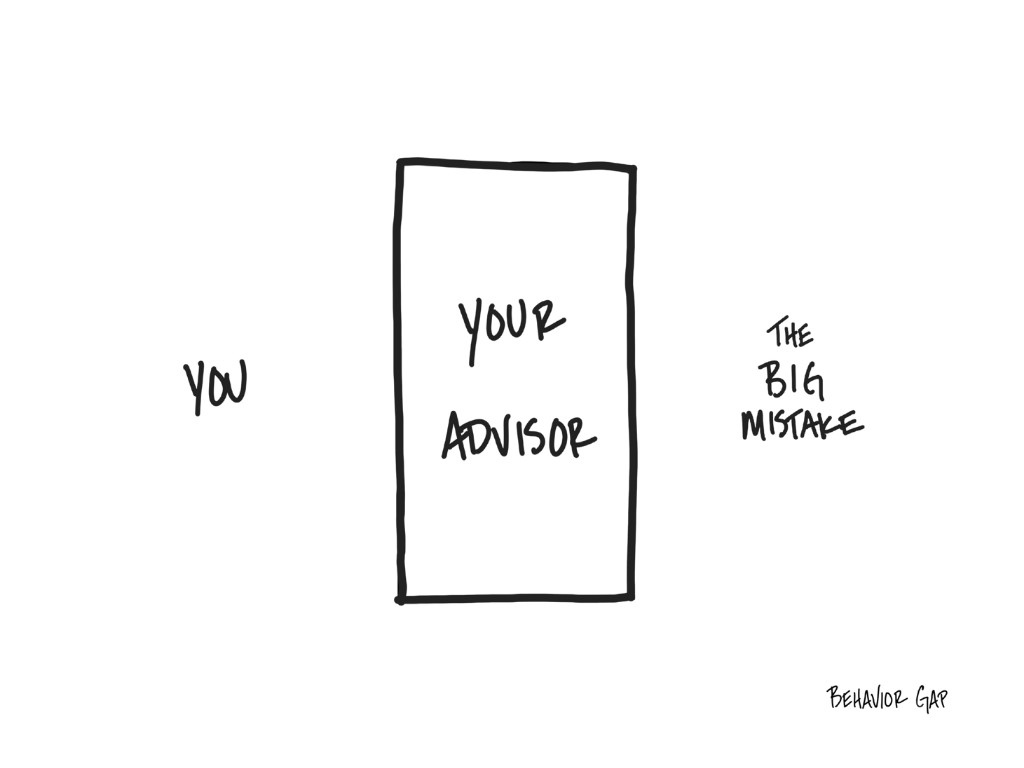
You can still chase what's hot, sell when you're frightened, and [00:16:00] abandon your plan at exactly the wrong time. Now, that takes me back to my conversation with Carl Richards in episode thirteen. Carl has a fantastic sketch called "The Big Mistake". You've got the investor on one side, the big mistake on the other, and the financial advisor standing in between. And as Carl explained when we talked, the point isn't that investors are dumb, it's that your advisor isn't you. They're able to see the blind spots that are incredibly difficult for us to see in ourselves. And if markets work, that may be one of the most valuable things an advisor can do, helping you build a plan and keeping you from abandoning it when things become uncomfortable.
So if you remember one thing from today's episode, I'd make it this: market efficiency does not mean the market is always right. It means you should be very humble about believing you know when it is wrong.
Capital markets have been incredibly effective wealth creation machines over time. Our job is to decide how much risk we need to take, diversify appropriately, keep unnecessary costs down, manage taxes where we [00:17:00] can, and then give our plan enough time to work.
Retirement investing comes down to one goal: capturing enough of what the market provides to fund the life you want to live. And the most reliable way I know to get there is also the least exciting one... stay out of the way.
Okay, I think that's it for today's episode. If you have any questions or would like any retirement-related topics answered on future episodes, please email us at info@retirereadypodcast.com.
Be sure to subscribe and give us a review on your favorite podcast player. If you're watching on YouTube, hit subscribe there too. It helps more Canadians find the show. You can also subscribe to The Wake Up, our semi-monthly newsletter, by visiting awakenwealth.ca.
I'll include all of the research and resources mentioned today in the show notes available at RetireReadyPodcast.com under episode fourteen. Be sure to check back in two weeks for part two of this series, Don't Play the Loser's Game, where we'll open up that scorecard on active managers.
Thanks again for [00:18:00] joining me today. I look forward to seeing you back for the next episode.
Thank you for listening to the Retire Ready podcast. To subscribe to this podcast or to learn more, please head over to RetireReadyPodcast.com. Investment services are provided through Awaken Investments of Aligned Capital Partners Incorporated, an approved trade name of Aligned Capital Partners Inc., or ACPI.
Only investment-related products and services are offered through ACPI or Awaken Investments of ACPI and covered by the Canadian Investor Protection Fund. Tax planning, financial planning, and insurance services are provided through Awaken Wealth Management Limited. Awaken Wealth is an independent company, separate and distinct from ACPI or Awaken Investments of ACPI.
Opinions and views expressed are those of Scott Sather, a registrant of ACPI, and may not necessarily be those of ACPI. This podcast is for informational purposes only and not intended to be personalized investment [00:19:00] advice. Content is prepared for general circulation, and information contained does not constitute an offer or a solicitation to buy or sell any investment fund, security, or other product or service
.webp)
Episode 13: Talking Your Money with Carl Richards
In this episode with talk with former financial advisor, author, and speaker Carl Richards to discuss his upcoming book, Your Money.

Episode 12: Freeing those Locked-In Funds
In this episode we talk about unlocking your pension plan or Locked-In Retirement Account or LIRA when you’re nearing or ready for retirement.


