A Surprise Winner Among Asset Classes
International stocks have quietly outperformed many expected leaders. Recent returns remind us that predicting market winners is difficult—and diversification m


When I started at Dimensional back in 2010, international stocks were a popular topic. That might have had something to do with the “lost decade” in which the S&P 500 Index posted a negative return.1 More recently, stoking interest in non-US investing has been like pulling teeth. Again, this was mostly tied to recent S&P 500 performance, which from 2011 to 2020 was tops among global stock categories. But something tells me international investments may be at the forefront again soon.
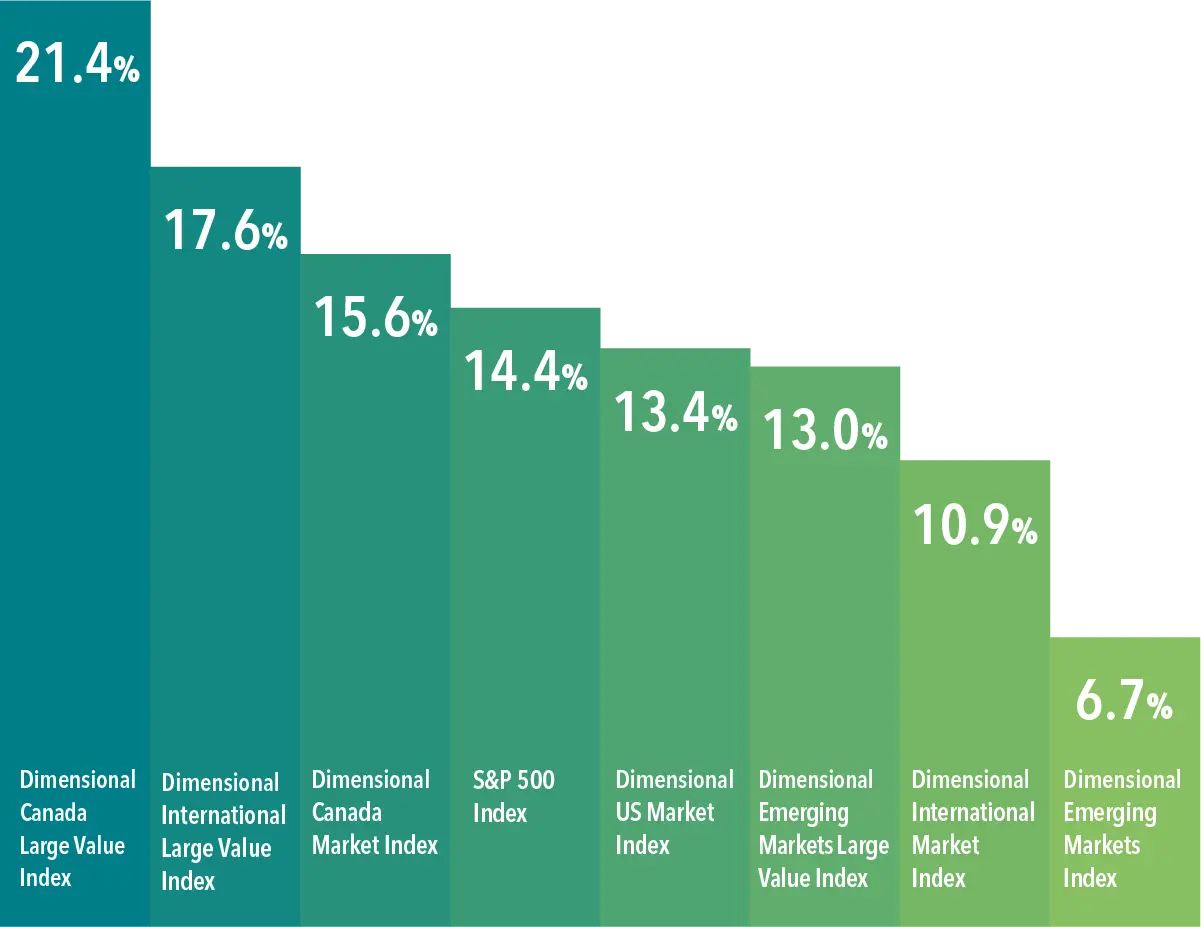
I have to admit that the recent five-year asset class return numbers snuck up on me, sort of like the popular Jason Momoa versus Henry Cavill meme. While the S&P remained near the top, non-US developed market value stocks quietly led among equity asset classes over this stretch. I can’t imagine many investors saw that coming, but it’s a good reminder of the challenge in predicting which markets will outperform.
EXHIBIT 1
Five-Year Returns for Asset Classes as of March 31, 2026
Footnotes
1. From January 2000 to December 2009, the S&P 500 Index annualized return was −0.95%.
Index Descriptions
The Dimensional indices have been retrospectively calculated by Dimensional Fund Advisors LP and did not exist prior to their index inception dates. Accordingly, results shown during the periods prior to each index’s inception date do not represent actual returns of the index. Other periods selected may have different results, including losses. Backtested index performance is hypothetical and is provided for informational purposes only to indicate historical performance had the index been calculated over the relevant time periods. Backtested performance results assume the reinvestment of dividends and capital gains. Profitability is defined as operating income before depreciation and amortization minus interest expense divided by book equity. Asset growth is defined as change in total assets from the prior fiscal year to current fiscal year.
Dimensional Canada Large Value Index was created in April 2008. January 1990–Present: Consists of large cap companies in eligible markets whose relative price is in the bottom 30% of their country’s large companies, after the exclusion of utilities and companies with either negative or missing relative price data. The index emphasizes companies with smaller capitalization, lower relative price, and higher profitability. The index also excludes those companies with the lowest profitability within their country’s large value universe. Profitability is defined as operating income before depreciation and amortization minus interest expense divided by book equity. The index monthly returns are computed as the simple average of the monthly returns of four subindices, each one reconstituted once a year at the end of each quarter of the year. Maximum index weight of any one company is capped at 10%. The country currently included is Canada. Exclusions: REITs and investment companies. Source: Bloomberg. The calculation methodology for the Dimensional Canada Large Value Index was amended in January 2014 to include profitability as a factor in selecting securities for inclusion in the index. The calculation methodology for the index was amended in November 2025 to limit sector concentration.
Dimensional International Large Value Index was created in April 2008. January 1990–Present: Consists of large cap companies in eligible markets whose relative price is in the bottom 30% of their country’s large companies, after the exclusion of utilities and companies with either negative or missing relative price data. The index emphasizes companies with smaller capitalization, lower relative price, and higher profitability. The index also excludes those companies with the lowest profitability within their country’s large value universe. Profitability is defined as operating income before depreciation and amortization minus interest expense divided by book equity. The index monthly returns are computed as the simple average of the monthly returns of four subindices, each one reconstituted once a year at the end of each quarter of the year. Maximum index weight of any one company is capped at 5%. Countries currently included are Australia, Austria, Belgium, Canada, Denmark, Finland, France, Germany, Hong Kong, Ireland, Israel, Italy, Japan, the Netherlands, New Zealand, Norway, Portugal, Singapore, Spain, Sweden, Switzerland, and the United Kingdom. Exclusions: REITs and investment companies. Source: Bloomberg. The calculation methodology was amended in January 2014 to include profitability as a factor in selecting securities for inclusion and in November 2025 to limit sector concentration.
Dimensional Canada Market Index was created in April 2008. January 1990–Present: Market-capitalization-weighted index of all securities in the eligible markets. The index monthly returns are computed as the simple average of the monthly returns of four subindices, each one reconstituted once a year at the end of each quarter of the year. Maximum index weight of any one company is capped at 10%. The country currently included is Canada. Exclusions: REITs and investment companies. Source: Bloomberg.
Dimensional US Market Index was created in March 2007. June 1927–Present: Market-capitalization-weighted index of securities of all US companies. The eligible market is composed of securities of US companies traded on the NYSE, NYSE MKT (formerly AMEX), and Nasdaq Global Market. Exclusions: non-US companies, REITs, UITs, and investment companies. Source: CRSP and Compustat.
Dimensional Emerging Markets Large Value Index was created in April 2008. January 1994–Present: Consists of large cap companies in eligible markets whose relative price is in the bottom 30% of their country’s large companies, after the exclusion of utilities and companies with either negative or missing relative price data. The index emphasizes companies with smaller capitalization, lower relative price, and higher profitability. The index also excludes those companies with the lowest profitability within their country’s large value universe. Profitability is defined as operating income before depreciation and amortization minus interest expense divided by book equity. The index monthly returns are computed as the simple average of the monthly returns of four subindices, each one reconstituted once a year at the end of each quarter of the year. Maximum index weight of any one company is capped at 5%. Countries currently included are Brazil, Chile, China, Colombia, the Czech Republic, Greece, Hungary, India, Indonesia, Kuwait, Malaysia, Mexico, Peru, the Philippines, Poland, Qatar, Saudi Arabia, South Africa, South Korea, Taiwan, Thailand, Turkey, and the UAE. Exclusions: REITs and investment companies. Source: Bloomberg. The calculation methodology was amended in January 2014 to include profitability as a factor in selecting securities for inclusion and in November 2025 to limit sector concentration.
Dimensional International Market Index was created in April 2008. January 1975–Present: Market-capitalization-weighted index of all securities in the eligible markets. The index monthly returns are computed as the simple average of the monthly returns of four subindices, each one reconstituted once a year at the end of each quarter of the year. Maximum index weight of any one company is capped at 5%. Countries currently included are Australia, Austria, Belgium, Canada, Denmark, Finland, France, Germany, Hong Kong, Ireland, Israel, Italy, Japan, the Netherlands, New Zealand, Norway, Portugal, Singapore, Spain, Sweden, Switzerland, and the United Kingdom. Exclusions: REITs and investment companies. Source: Bloomberg.
Dimensional Emerging Markets Index was created in April 2008. January 1990–present: Market-capitalization-weighted index of all securities in the eligible markets. Maximum index weight of any one company is capped at 5%. Countries currently included are Brazil, Chile, China, Colombia, the Czech Republic, Greece, Hungary, India, Indonesia, Kuwait, Malaysia, Mexico, Peru, the Philippines, Poland, Qatar, Saudi Arabia, South Africa, South Korea, Taiwan, Thailand, Turkey, and the UAE. Exclusions: REITs and investment companies. Source: Bloomberg. The index monthly returns are computed as the simple average of the monthly returns of four subindices, each one reconstituted once a year at the end of each quarter of the year.
Disclosures
All expressions of opinion are subject to change. This information is not meant to constitute investment advice, a recommendation of any securities product or investment strategy (including account type), or an offer of any services or products for sale, nor is it intended to provide a sufficient basis on which to make an investment decision. Investors should consult with a financial professional regarding their individual circumstances before making investment decisions. Diversification neither assures a profit nor guarantees against loss in a declining market.
Risks include loss of principal and fluctuating value.
CANADA
These materials have been prepared by Dimensional Fund Advisors Canada ULC. The other Dimensional entities referenced herein are not registered resident investment fund managers or portfolio managers in Canada.
This material is not intended for Quebec residents.
Commissions, trailing commissions, management fees, and expenses all may be associated with mutual fund investments. Please read the prospectus before investing. Unless otherwise noted, any indicated total rates of return reflect the historical annual compounded total returns, including changes in share or unit value and reinvestment of all dividends or other distributions, and do not take into account sales, redemption, distribution, or optional charges or income taxes payable by any security holder that would have reduced returns. Mutual funds are not guaranteed, their values change frequently, and past performance may not be repeated.
Resources